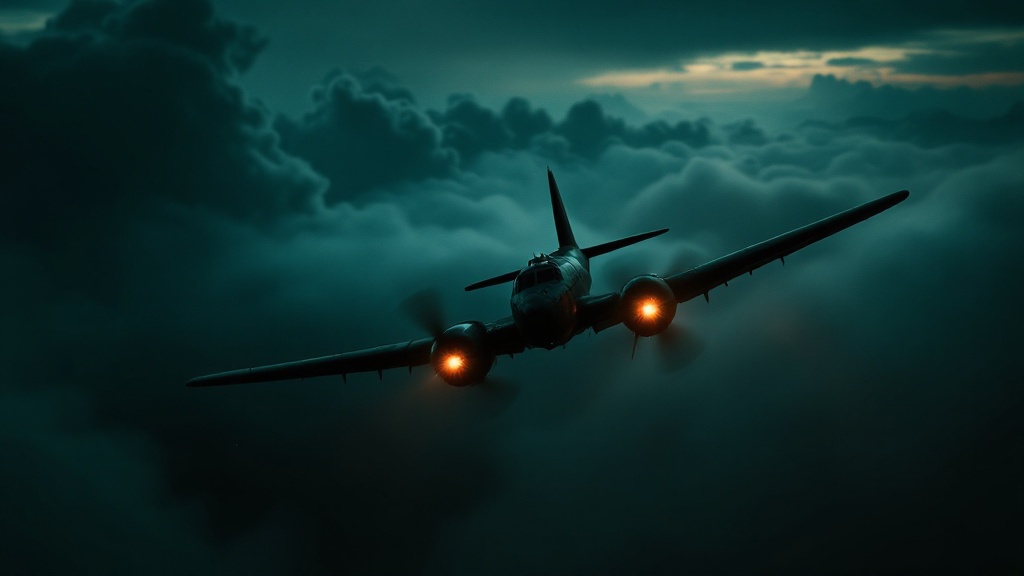
Foo Fighters of WWII: The 415th Night Fighter Squadron Files
The first military UAP reports in American history did not happen in 1947.
They happened in November 1944, over the Rhine Valley, at 200 miles per hour, in a Bristol Beaufighter flown by the 415th Night Fighter Squadron.
The crew saw eight to ten bright orange lights off the left wing. The radar showed nothing. Ground control showed nothing. The pilot turned toward the lights. They disappeared. They reappeared farther away. The display continued for several minutes, then stopped.
That is the opening entry of what became the foo fighter files: a collection of wartime reports from Allied night fighter crews who encountered luminous, maneuverable objects over Germany and France between November 1944 and the end of the war in Europe.
The reports are now part of the public record. They appear in the PURSUE archive and have been discussed by the Smithsonian’s Air & Space Magazine and the History Channel. The 415th’s war diary entries and mission reports are also available through the National Archives and have been transcribed by researchers over the years.
But the significance of the foo fighter files is not just that they are old.
The way these reports were written, by trained military observers through official channels and without speculation, is identical to how modern UAP mission reports are written in the PURSUE archive. The format changed. The discipline did not.
What the 415th Night Fighter Squadron Reported
The 415th Night Fighter Squadron was a specialized unit. Night fighting in WWII required radar-equipped aircraft and crews who operated in conditions where visual identification was already difficult. These were not casual witnesses. They were trained to operate in the dark, distinguish threats from artifacts, and report what they saw through military channels.
The first widely cited encounter took place in late November 1944. Lieutenant Fred Ringwald, an intelligence officer riding as an observer in a Beaufighter piloted by Lieutenant Edward Schlueter, with radar operator Lieutenant Donald J. Meiers, was flying along the Rhine north of Strasbourg. The crew reported seeing mysterious, glowing, and rapidly maneuvering spheres of light alongside their aircraft: eight to ten bright orange lights off the left wing, moving at high speed. Schlueter turned toward them. The lights disappeared. They reappeared farther away. The encounter lasted several minutes.
Airborne radar picked up nothing. Ground control picked up nothing.
That last detail matters more than the lights themselves. A visual sighting without radar correlation is ambiguous. It could be ground lights, reflections, atmospheric phenomena, or something else. But the crew reported it anyway, through official channels, because the objects behaved in a way that did not fit the usual explanations. They moved. They responded to the aircraft’s maneuver. They disappeared and reappeared.
The reports kept coming.
On December 17, 1944, the 415th’s war diary records: “In Rastatt area sighted five or six red and green lights in a ‘T’ shape which followed A/C thru turns and closed to 1000 feet. Lights followed for several miles then went out.”
On December 23: “More Foo-Fighters were in the air last night. The Ops. Report says: ‘In vicinity of Hagenau Saw 2 lights coming Toward A/C from ground. After reaching the altitude of the A/C they leveled off and flew on the tail of Beau for 2 minutes And they peeled up and turned away.’”
These are not vague descriptions. They are operational reports written in the same format as any other combat mission report. They include location, altitude, duration, and the object’s behavior relative to the aircraft. The language is restrained. The pilots did not claim the objects were alien or German secret weapons. They reported what they saw and let the intelligence system sort it out.
That is the same approach the Department of War uses today.
The Name Came From a Comic Strip
The term “foo fighters” was coined by Donald J. Meiers, the radar observer on the first reported flight. He took the word from a popular comic strip of the era called “Smokey Stover,” in which a firefighter character would say “Where there’s foo, there’s fire.” The nonsense word “foo” had no meaning beyond the comic. Meiers used it as a label for something the crew could not identify.
That detail is worth pausing on.
The crew did not name the objects after a mythological creature or a foreign technology. They used a nonsense word from a comic strip. That choice tells you something about the reporting culture of the 415th: they were not trying to explain what they saw. They were labeling it for filing.
A modern parallel exists in the PURSUE archive. The Department of War’s current UAP reporting system uses the term “UAP” (Unidentified Anomalous Phenomena) not because the term explains anything, but because it avoids the assumptions built into older terms like “UFO.” The 415th’s “foo fighters” served the same function in 1944: a placeholder label that let the reporting system work without requiring the observer to commit to an explanation.
What the Files Show About Reporting Discipline
The foo fighter reports were collected by SHAEF (Supreme Headquarters Allied Expeditionary Force), the command structure led by General Eisenhower. The SHAEF file, referenced in the National Archives as 37153, collects messages and witness reports from January through March 1945, covering the 415th Night Fighter Squadron and other Allied units.
What makes the SHAEF file valuable is not the sightings themselves. It is the institutional response.
The reports were collected and circulated through command channels. They were treated as operational observations, not as folklore. The 415th’s war diary entries are written in the same tone as any other mission report: the foo fighter observations are logged alongside combat engagements and patrol results. There is no special folder labeled “mysterious.” The reports sit in the operational record because that is where they originated.
Richard Ziebart, historian for the nearby 417th Night Fighter Squadron, heard many of the stories directly from 415th crew members. He described the pilots as “very professional. They gave the report, talked about the lights, but didn’t speculate about them.” One 415th pilot described feeling “scared shitless” to Keith Chester, author of Strange Company: Military Encounters With UFO’s in World War II. But that fear did not enter the official report. The report described what was observed. The fear stayed in the cockpit.
That separation, between what was felt and what was reported, is the defining characteristic of good military UAP documentation. It is also what makes the modern PURSUE files readable. When a DOW mission report from 2022 describes a “spherical UAP” over the Persian Gulf, it does not say the crew was frightened. It says what the sensor recorded and what the object did. The emotional content is absent. The operational content is precise.
The 415th’s reports from 1944 follow the same principle. The format is different (a typed war diary versus a digital sensor log), but the discipline is identical.
How the Foo Fighter Reports Compare to Modern PURSUE Files
The comparison is not a stretch. It is structural.
Consider the 2020 Persian Gulf UAP cluster, which groups multiple military sightings from the same geographic area over a sustained period. The 415th’s foo fighter reports are the same pattern in a different era: multiple sightings, same geographic area (the Rhine Valley), sustained period (November 1944 through spring 1945), same type of observer (trained military aircrew), and the same core observation (luminous objects that maneuvered in ways that did not fit known explanations).
Or consider the Syrian UAP acceleration clip, a modern DOW file that shows an object exhibiting instantaneous acceleration on infrared video. The 415th’s reports describe objects that “went straight up” and disappeared, a qualitative description of the same kind of behavior that the Syrian video captures on sensor. The 1944 crew had no infrared camera. They had their eyes and a war diary. But they described the same flight characteristics that modern sensor platforms record digitally.
The 28 military UAP videos released through PURSUE span from a 2013 Mediterranean encounter to a 2026 Department of the Army recording. They represent the modern continuation of what the 415th started: trained military observers documenting anomalous aerial phenomena through official channels.
The difference is that the modern files come with sensor data: infrared video, radar tracks, mission metadata. The 415th’s files come with human observation only. That makes the modern files more analytically powerful. But it also makes the 1944 files more historically significant. They prove that the pattern of military UAP encounters predates the sensor era by decades.
Why the War Ended Before Anyone Could Investigate
The foo fighter reports never received a formal investigation during the war.
The reason is simple: the war was still being fought. The Battle of the Bulge began in December 1944. The crossing of the Rhine began in March 1945. Germany surrendered in May 1945. The 415th Night Fighter Squadron was flying combat missions throughout this period. There was no institutional capacity to investigate anomalous lights when the operational tempo was at its peak.
After the war, the reports entered the archival record but did not trigger a formal study. Project Sign, the first U.S. Air Force investigation of UFOs, was not established until 1947, and it was prompted by the Kenneth Arnold sighting, not by the foo fighter files. By then, the 415th’s reports were nearly three years old. The crews had dispersed. The Beaufighters were obsolete. The Rhine Valley was no longer a combat zone.
That gap, between the first reports and the first formal investigation, is a recurring pattern in UAP history. The Sandia green fireball reports from 1948-1950 also took months before they triggered an organized reporting system. The modern PURSUE archive itself exists because the government spent decades collecting UAP reports without a centralized public-facing system. The pattern is: observations first, institutional response later.
The foo fighter files are the earliest known instance of this pattern in the American military record.
What the Foo Fighter Files Do Not Prove
This is where the reading has to be careful.
The foo fighter files do not prove the objects were exotic technology. They do not prove they were German secret weapons. They do not prove they were extraterrestrial.
They prove something narrower and more useful.
They prove that trained military observers, night fighter crews whose job required them to distinguish real threats from sensor artifacts in the dark, reported objects that did not fit their operational understanding of what should be in the sky. They reported these observations through official military channels. The reports were collected and archived by the Allied command structure. And the reports described flight characteristics (maneuverability, response to aircraft movement, disappearance and reappearance) that remain consistent with UAP reports from every subsequent decade.
That is not a conclusion about origin. It is a conclusion about pattern.
The pattern is: for at least 80 years, trained military observers have been reporting the same category of aerial phenomenon. Luminous. Maneuverable. Sometimes radar-invisible. Unexplained by the observers who encountered them. The 415th Night Fighter Squadron did not have the tools to resolve what they saw. The modern DOW mission reports have better tools but often reach the same outcome: the object remains unidentified.
The continuity of the pattern is the evidence. The foo fighter files are where that pattern begins.
Common Questions About the Foo Fighter Files
Were the foo fighters German secret weapons?
This was the first theory the 415th considered. The reports came from over Germany, during wartime, and the objects appeared near combat operations. But several details argue against it. The objects did not appear on radar, which was unusual for any aircraft of the era. They followed aircraft but did not attack. And post-war investigation of German records found no program that matched the described behavior. The theory was reasonable in 1944. It does not hold up against the available evidence.
What did the CIA Robertson Panel conclude about foo fighters?
The CIA’s Scientific Advisory Panel on Unidentified Flying Objects, better known as the Robertson Panel after its chairman H.P. Robertson, met for five days in January 1953. The panel reviewed a selection of the best-documented UFO cases from the early 1950s, including some of the same nocturnal-light reports that echoed the 415th’s wartime observations.
The Robertson Panel’s conclusion was institutional, not explanatory. The panel did not identify the foo fighters. It did not identify any of the cases it reviewed. Instead, it concluded that the phenomenon did not constitute a direct physical threat to national security and recommended that the intelligence community downplay public interest in UFOs to prevent information overload.
That recommendation is the connection. The foo fighter reports from 1944 had entered a classified intelligence pipeline. By 1953, that pipeline had produced enough high-quality cases that the CIA convened a panel of scientists to decide what to do about them. The panel’s answer was to manage the public reaction, not to solve the mystery. That management approach, keeping the observations in the classified system while minimizing public attention, shaped the institutional handling of UAP for the next seven decades.
Were the foo fighters St. Elmo’s Fire?
St. Elmo’s Fire, a luminous plasma phenomenon that can appear on aircraft surfaces in stormy conditions, is one of the most common conventional explanations. It fits some of the visual descriptions (luminous, colored lights near the aircraft). But it does not fit the reported behavior. St. Elmo’s Fire is stationary relative to the aircraft. The 415th’s reports describe objects that moved independently, responded to aircraft maneuvers, disappeared and reappeared, and in some cases “flew on the tail” of the aircraft before peeling away. That is not how plasma behaves.
Did the foo fighters ever appear on radar?
No. In every reported case where radar was operating, the objects did not register on airborne radar or ground control. This is one of the most consistent details across the 415th’s reports and one of the hardest to explain. It also recurs in modern UAP reports: some objects are visible on one sensor system but not another, or visible to the eye but not to radar. The 415th’s radar operator, Donald J. Meiers, was a trained professional. If the objects were radar-reflective, he would have seen them.
How many foo fighter sightings were there?
The exact count is uncertain because the reports are scattered across war diary entries and SHAEF memoranda. The 415th Night Fighter Squadron reported encounters on multiple missions between November 1944 and spring 1945. Other Allied units also reported similar lights, though the 415th’s reports are the most thoroughly documented. The SHAEF file collects reports from several units, not just the 415th.
Did other Allied squadrons report foo fighters?
Yes. The 415th Night Fighter Squadron is the best-known source because its war diary was preserved, but the phenomenon was not limited to one unit. The 417th Night Fighter Squadron, also operating in the European theater, collected similar reports from its own crews. The SHAEF memoranda include observations from multiple Allied units operating over Germany and France in late 1944 and early 1945.
The consistency across units is important. If the foo fighters were a localized hallucination or a specific aircraft malfunction, they would likely have appeared only to one squadron. Instead, reports came from multiple crews, in different aircraft, operating in different areas, over a period of months. The military publication Task & Purpose has also noted that the sightings were widely reported enough to become a recognized phenomenon among Allied aircrews, not merely a legend attached to one unit.
How did the term “foo fighters” inspire the rock band Foo Fighters?
The rock band Foo Fighters, formed by Dave Grohl in 1994 after the death of Nirvana’s Kurt Cobain, took its name directly from the 415th’s wartime term. Grohl has said the name suggested a kind of secret identity: a group of unknowns, named after a group of unknowns. The band’s first album was a solo project by Grohl, released with the name “Foo Fighters” as a placeholder, and the name stayed.
The naming is not a trivial detail. It shows how deeply the foo fighter reports have entered American culture. The same phrase that started as a comic-strip nonsense label in a 1944 war diary became the name of a Grammy-winning rock band fifty years later. That cultural persistence is separate from the question of what the objects actually were. But it shows that the 415th’s reports did not disappear into the archives. They became one of the most recognizable UFO terms in popular culture.
Are the foo fighter files in the PURSUE archive?
The PURSUE archive at war.gov/UFO includes historical documents spanning multiple decades. The WWII-era foo fighter records from the 415th Night Fighter Squadron and SHAEF are part of the broader government UAP record. However, the files are historical: they are typed documents and war diary entries, not modern sensor data. They require a different reading method than the modern DOW mission reports that dominate the recent PURSUE releases.
What This Means for UAP Research Today
The foo fighter files matter for a few reasons that are worth stating plainly.
First, they establish a baseline. Any claim that military UAP encounters are a recent phenomenon, a product of modern sensors or modern cultural framing, has to contend with the 415th’s reports from 1944. The encounters predate the term “UFO” by three years, predate Project Sign by three years, and predate the Kenneth Arnold sighting by two and a half years. The pattern was there before the vocabulary existed.
Second, they show that the reporting culture is consistent. The 415th’s pilots reported what they saw, through official channels, without speculation. They did not claim the objects were alien or German weapons. They described the behavior and let the system sort it out. That is the same culture that produces the modern PURSUE mission reports. The institutional discipline is the same. Only the technology has changed.
Third, the unresolved category is stable. In 1944, the 415th’s reports were unresolved. In 2026, many of the PURSUE DOW mission reports are unresolved. The objects described in both eras share core characteristics: luminous, maneuverable, sometimes radar-invisible, and not attributable to known technology by the observers who encountered them. Eighty years of better sensors and better reporting systems have not resolved the core category. They have only documented it more precisely.
That is not proof of any particular origin. It is proof that the phenomenon, whatever it is, has been there for as long as we have been writing it down.
The 415th Night Fighter Squadron was the first to write it down.
Flynn Lin is the founder and editor of UFO Declassified. You can reach him at contact@ufo-declassified.com for corrections, tips, or questions about any record on this site. Read more about the PURSUE archive or browse all declassified documents.